High PSA Levels: Can It Be High Without Prostate Cancer?
Understanding Prostate-Specific Antigen (PSA), Benign Causes of Elevated PSA, and Advanced Diagnostic Screening After Age 40.
Book ConsultationQuick Summary
- PSA is prostate-specific, not cancer-specific; an elevated level indicates prostate tissue activity or irritation, not an automatic cancer diagnosis.
- Up to 70–75% of men with an elevated PSA level between 4.0 and 10.0 ng/mL do NOT have prostate cancer.
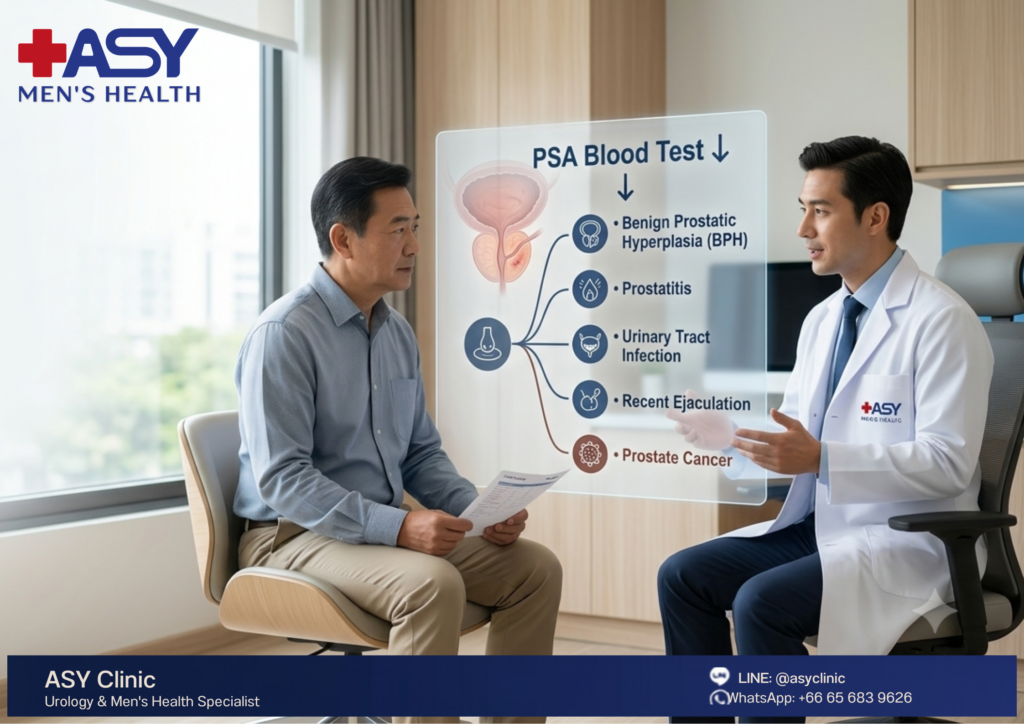
- Common benign causes include Benign Prostatic Hyperplasia (BPH), prostatitis, urinary tract infections, recent ejaculation, and vigorous cycling.
- A single elevated PSA result should never prompt an immediate prostate biopsy without secondary confirmation and advanced biomarkers.
- Advanced metrics such as Free PSA ratio, PSA Density, PSA Velocity, and multiparametric MRI provide significantly higher diagnostic precision.
Table of Contents
1. The Anxiety of an Elevated PSA Result 2. Benign (Non-Cancerous) Causes of High PSA 3. BPH vs. Prostatitis vs. Prostate Cancer 4. How Precision Longevity Evaluates Elevated PSA 5. Who Should Monitor Their PSA? 6. The ASY Clinic Approach to Prostate Health 7. Key Takeaways1. The Anxiety of an Elevated PSA Result
Receiving a blood test result showing an elevated Prostate-Specific Antigen (PSA) level is one of the most anxiety-inducing moments for men undergoing routine Preventive Health Screening. The initial assumption is often immediate and overwhelming: "Do I have prostate cancer?"
However, modern urological science provides a far more reassuring reality: PSA is a protein specific to the prostate gland, not a biomarker specific to cancer.
An elevated PSA level acts like a biological "check engine light" for the prostate. It signals that prostate tissue is experiencing physiological changes, enlargement, inflammation, physical trauma, or cellular activity. In fact, the majority of men found to have an elevated PSA during a Men's Health Check turn out to have benign (non-cancerous) conditions.
For men past age 40 considering a Health Check-up After 35 or 40, understanding what drives PSA fluctuations is essential for avoiding unnecessary medical panic and taking the correct diagnostic next steps.
2. Benign (Non-Cancerous) Causes of High PSA
When healthy prostate architecture is disrupted, more PSA leaks into surrounding blood vessels. Several common, non-cancerous conditions cause significant PSA spikes:
1. Benign Prostatic Hyperplasia (BPH)
As men age, the prostate naturally enlarges under hormonal influence. This non-cancerous growth is called Benign Prostatic Hyperplasia (BPH). Because a larger prostate contains more total tissue, it naturally produces more total PSA. A larger gland almost always yields a higher baseline PSA level without any cancer being present.
2. Prostatitis & Inflammation
Prostatitis—inflammation or infection of the prostate gland—is one of the most frequent causes of dramatic PSA spikes. Acute bacterial prostatitis can disrupt prostate cell membranes, causing large amounts of PSA to spill into the bloodstream (sometimes pushing levels above 10.0 or 20.0 ng/mL temporarily). Once inflammation subsides, PSA levels typically return to normal.
3. Urinary Tract Infections (UTIs) & Retention
An infection spreading through the urinary tract can irritate surrounding prostatic tissue. Severe urinary retention or recent urological procedures (such as catheterization or prostate exams) also place mechanical strain on the gland, causing temporary surges in PSA.
4. Recent Ejaculation & Physical Friction
Sexual activity involving ejaculation within 48 hours prior to a blood draw can cause a temporary PSA rise of 0.8 to 2.0 ng/mL. Similarly, long-distance bicycle riding places direct pressure on the perineum and prostate, causing temporary friction leaks.
3. BPH vs. Prostatitis vs. Prostate Cancer
Comparing clinical features helps clarify how different prostate conditions behave:
| Clinical Feature | Benign Prostatic Hyperplasia (BPH) | Prostatitis (Inflammation) | Prostate Cancer |
|---|---|---|---|
| Primary Cause | Age-related non-cancerous tissue expansion. | Bacterial infection or chronic tissue inflammation. | Malignant cellular transformation in prostate tissue. |
| PSA Elevation Pattern | Gradual, slow rise over several years. | Sudden, sharp elevation (often double or triple). | Steady, continuous progression over time. |
| Typical Symptoms | Weak stream, night urination (nocturia), hesitancy. | Pelvic pain, fever, painful urination or ejaculation. | Often completely asymptomatic in early stages. |
| Free-to-Total PSA Ratio | Usually High (> 25%). | Variable (often normal to high after recovery). | Usually Low (< 15–18%). |
💡 Medical Pearl: Pre-Test Protocol
To prevent false PSA spikes during your Prostate Health Screening, abstain from sexual activity/ejaculation and vigorous bicycle riding for at least 48 to 72 hours prior to your blood draw.
4. How Precision Longevity Evaluates Elevated PSA
In conventional medicine, a PSA reading above 4.0 ng/mL often led directly to an invasive prostate needle biopsy. Modern Precision Longevity and specialized urological care take a far more refined, non-invasive diagnostic pathway:
- Repeat Baseline Testing: Re-testing after ruling out recent ejaculation, physical trauma, or urinary tract infection.
- Free PSA Ratio (% Free PSA): Measuring unbound PSA in the blood. Men with BPH tend to have a higher percentage of Free PSA (> 20–25%), whereas prostate cancer typically presents with a lower percentage (< 15%).
- PSA Density (PSAD) & Velocity (PSAV): PSAD divides total PSA by prostate volume (via ultrasound/MRI), while PSAV tracks the speed of PSA rise over time.
- Multiparametric MRI (mpMRI): High-resolution 3D imaging allows specialists to visualize suspicious lesions before deciding whether a biopsy is necessary.
5. Who Should Monitor Their PSA?
Prostate health monitoring should be a core component of a Personalized Health Assessment for adult men:
- Men Aged 45–50: All men should establish a baseline PSA reading as part of their routine Healthy Aging plan.
- Men Aged 40+ with Family History: Individuals with a father or brother diagnosed with prostate cancer have a higher baseline risk and should begin screening earlier.
- Men Experiencing Lower Urinary Tract Symptoms: Men noticing weak stream, night waking, or urinary urgency.
- Men Considering Testosterone Optimization: Men evaluating Testosterone Replacement Therapy (TRT) require baseline and periodic PSA tracking to ensure prostate safety.
6. The ASY Clinic Approach to Prostate Health
At ASY Clinic, prostate health is evaluated through a comprehensive precision medicine framework:
- Comprehensive Biomarker Profiling: Combining Total PSA, Free PSA ratio, inflammatory markers, and metabolic parameters.
- Specialist Urologist Consultation: Expert clinical evaluation by experienced urologists to accurately differentiate BPH from cancer risk.
- Non-Invasive Diagnostic Pathways: Utilizing mpMRI and advanced PSA velocity metrics to prevent unnecessary needle biopsies.
- Integrated Men's Health Care: Aligning prostate screening with Testosterone Optimization and long-term healthspan extension.
7. Key Takeaways
- High PSA Does Not Mean Cancer: Up to 75% of elevated PSA readings in the 4.0–10.0 ng/mL range are caused by benign conditions like BPH or inflammation.
- Always Confirm Before Acting: Rule out temporary spikes caused by recent sex, cycling, or minor infections via repeat testing.
- Utilize Advanced Biomarkers: Free PSA percentage, PSA Density, and PSA Velocity provide much greater diagnostic accuracy than total PSA alone.
- Proactive Screening: Baseline PSA screening after age 40–45 allows for early detection of both benign urinary conditions and serious prostate disease when treatments are most effective.
Frequently Asked Questions
Can ejaculation or sex cause a high PSA reading?
Yes. Ejaculation within 48 hours prior to a blood draw can cause a temporary rise in total PSA levels (typically increasing values by 0.8 to 2.0 ng/mL). Men should abstain from sexual activity for 48 hours before undergoing a PSA test.
What is considered a normal PSA level?
Historically, a total PSA below 4.0 ng/mL was considered standard. However, age-adjusted targets are more accurate: Ages 40–49 (< 2.5 ng/mL), Ages 50–59 (< 3.5 ng/mL), and Ages 60–69 (< 4.5 ng/mL). Physicians evaluate trends over time rather than relying on a single rigid cutoff.
Does Benign Prostatic Hyperplasia (BPH) turn into prostate cancer?
No. BPH is a benign growth of inner prostate tissue around the urethra, whereas prostate cancer usually arises in the outer peripheral zone. BPH does not cause or evolve into prostate cancer, though a man can have both conditions simultaneously.
Does Testosterone Replacement Therapy (TRT) cause prostate cancer?
Modern scientific evidence demonstrates that medically supervised TRT does not cause prostate cancer. However, testosterone can stimulate pre-existing prostate cancer cells, which is why baseline PSA screening and ongoing urological monitoring are mandatory before and during hormone therapy.
About the Author
Dr. Sirirat Nakdang
นพ. สิริรัฐ นาคแดง
ศัลยแพทย์ทางเดินปัสสาวะและระบบสืบพันธุ์เพศชาย
Urologist & Men's Reproductive Surgeon
Sirirat Nakdang, MD
Urologist & Men's Health Specialist
Thai Medical License No. ว55466
References
- Grubb, R. L., et al. (2008). Prostate-specific antigen testing: normal limits and age-adjusted ranges. Urologic Clinics of North America, 35(2), 163–170.
- Catalogna, M., et al. (2020). The role of Free/Total PSA ratio in preventing unnecessary prostate biopsies. World Journal of Urology, 38(7), 1711–1719.
- Mottet, N., et al. (2021). EAU-EANM-ESTRO-ESUR-SIOG Guidelines on Prostate Cancer. European Association of Urology Guidelines, 79(2), 243–262.
- Bhasin, S., et al. (2018). Testosterone Therapy in Men With Hypogonadism: An Endocrine Society Clinical Practice Guideline. The Journal of Clinical Endocrinology & Metabolism, 103(5), 1715–1744.
Precision Prostate Program
Evidence-based prostate screening with Total & Free PSA, multiparametric MRI, and urologist consultation.
Book Consultation
Peptides and Healthy Aging: Evidence vs Experimental | Peptide Pattaya