
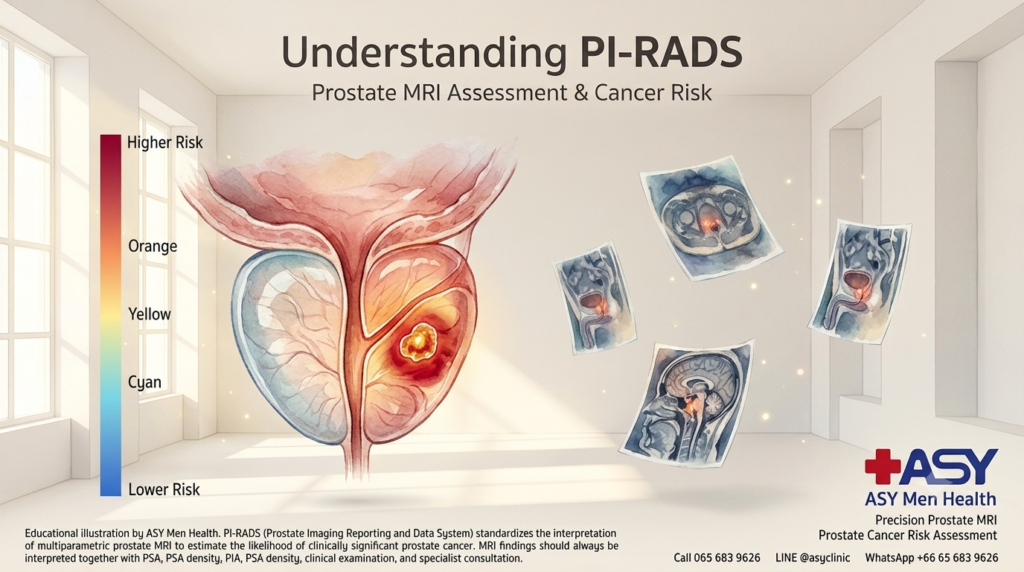
A clinical guide to understanding Prostate Imaging-Reporting and Data System (PI-RADS) scores, mpMRI interpretation, and urological management.
Book ConsultationQuick Summary
- Standardized Scoring System: PI-RADS (Prostate Imaging-Reporting and Data System) is an international clinical framework used to evaluate the likelihood of clinically significant prostate cancer on multiparametric MRI (mpMRI).
- 5-Point Risk Scale: Scores range from PI-RADS 1 (very low risk) to PI-RADS 5 (very high risk of aggressive cancer).
- Biopsy Decision Guide: PI-RADS 1 and 2 allow urologists to safely avoid unnecessary biopsies, whereas PI-RADS 4 and 5 strongly indicate the need for targeted tissue sampling.
- Multiparametric Sequences: Evaluates structural anatomy (T2W), tissue cellular density (DWI), and blood vessel dynamics (DCE) to pinpoint abnormal lesions.
- Precision Targeting: High PI-RADS scores guide millimeter-accurate MRI-TRUS Fusion Biopsies, maximizing diagnostic accuracy while minimizing sampling errors.
Table of Contents
1. What Is PI-RADS? 2. How mpMRI Evaluates the Prostate 3. Detailed Breakdown of PI-RADS Scores (1 to 5) 4. Clinical Recommendations Based on PI-RADS Score 5. What Happens if Your Score Is PI-RADS 4 or 5? 6. The ASY Clinic Urological Health Protocol 7. Key Takeaways1. What Is PI-RADS?
PI-RADS stands for Prostate Imaging-Reporting and Data System. Developed jointly by the American College of Radiology (ACR), European Society of Urogenital Radiology (ESUR), and AdMeTech Foundation, PI-RADS is a global standardized system designed to interpret and report Multiparametric Magnetic Resonance Imaging (mpMRI) scans of the prostate.
When a patient presents with an elevated Prostate-Specific Antigen (PSA) level or abnormal Digital Rectal Examination (DRE), an mpMRI scan is performed. The radiologist uses PI-RADS to classify any detected abnormality on a 5-point scale based on the likelihood that the lesion represents clinically significant prostate cancer (defined as Gleason score ≥ 7 / ISUP grade group ≥ 2).
By standardizing image interpretation, PI-RADS improves diagnostic accuracy, reduces inter-observer variability, and helps urologists make precise treatment decisions.
2. How mpMRI Evaluates the Prostate
Standard imaging often fails to clearly distinguish benign prostate tissue from malignant tumors. Multiparametric MRI (mpMRI) overcomes this limit by combining multiple functional sequences:
- T2-Weighted Imaging (T2W): Displays detailed anatomical structures of the peripheral and transition zones of the prostate.
- Diffusion-Weighted Imaging (DWI): Measures water molecule movement in tissue; dense cancer cells restrict water diffusion, appearing brightly on DWI maps.
- Dynamic Contrast-Enhanced (DCE) Imaging: Tracks the inflow of intravenous contrast agent to evaluate tumor microvascularity and rapid blood flow.
The combination of these parameters provides radiologists with a complete 3D assessment of prostate tissue density, location, and tumor characteristics.
3. Detailed Breakdown of PI-RADS Scores (1 to 5)
The PI-RADS classification ranges from 1 to 5. Each category corresponds to a specific risk level for significant prostate cancer:
| PI-RADS Score | Risk Assessment | Likelihood of Clinically Significant Cancer |
|---|---|---|
| PI-RADS 1 | Very Low | Clinically significant cancer is highly unlikely to be present. |
| PI-RADS 2 | Low | Clinically significant cancer is unlikely to be present. |
| PI-RADS 3 | Intermediate (Equivocal) | Presence of clinically significant cancer is uncertain/borderline. |
| PI-RADS 4 | High | Clinically significant cancer is likely to be present. |
| PI-RADS 5 | Very High | Clinically significant cancer is highly likely (large/invasive lesion). |
💡 Clinical Pearl: Understanding PI-RADS 3
A PI-RADS 3 score is considered an "equivocal" or borderline result. Rather than rushing into an immediate biopsy, urologists evaluate secondary biomarkers—such as PSA Density (PSAD), free-to-total PSA ratio, or patient age—to determine whether a biopsy or close clinical monitoring is most appropriate.
4. Clinical Recommendations Based on PI-RADS Score
PI-RADS scoring transforms prostate cancer screening by replacing routine "blind" biopsies with risk-stratified clinical care:
- PI-RADS 1 & 2 (Reassuring): Patients can safely avoid an invasive prostate biopsy. Urologists recommend ongoing PSA monitoring and routine follow-up.
- PI-RADS 3 (Intermediate): Clinical decision depends on PSA density. If PSAD is <0.15 ng/mL/cc, active surveillance is often chosen; if PSAD is high, a targeted biopsy may be recommended.
- PI-RADS 4 & 5 (Suspicious): Tissue confirmation is required. A targeted prostate biopsy should be performed to obtain histopathological grading (Gleason Score).
5. What Happens if Your Score Is PI-RADS 4 or 5?
If your mpMRI report indicates a PI-RADS 4 or 5 score, it means a suspicious lesion was clearly identified inside the prostate gland.
Instead of a traditional 12-core random ultrasound biopsy, urologists use MRI-TRUS Fusion Biopsy technology. This state-of-the-art procedure overlays 3D MRI target maps onto real-time transrectal or transperineal ultrasound images during tissue sampling.
MRI Fusion Biopsy allows the urologist to guide the needle with millimeter precision directly into the heart of the suspicious lesion, ensuring accurate diagnostic grading while minimizing unnecessary needle passes.
6. The ASY Clinic Urological Health Protocol
At ASY Clinic, prostate health evaluations combine cutting-edge imaging with expert urological care:
- Urologist-Led Risk Stratification: Comprehensive evaluation combining PSA levels, PSA Density (PSAD), and physical examination.
- High-Field mpMRI Screening: Direct referral pathways for 3T multiparametric MRI to ensure crystal-clear imaging interpretation.
- MRI-TRUS Fusion Biopsy Access: Direct referral for 3D targeted fusion biopsies when PI-RADS 4 or 5 lesions are detected.
- Holistic Men's Health Integration: Managing Benign Prostatic Hyperplasia (BPH), urinary flow symptoms, and long-term prostate wellness.
7. Key Takeaways
- Standardized Guidance: PI-RADS is a 1-to-5 scoring system used on multiparametric MRI to assess prostate cancer risk.
- Saves Unnecessary Biopsies: Scores of PI-RADS 1 and 2 allow up to 30% of men with elevated PSA to safely skip invasive needle biopsies.
- Identifies Aggressive Cancers: PI-RADS 4 and 5 highlight high-risk lesions that require immediate targeted biopsy.
- Specialist Interpretation: Always review your MRI report and PI-RADS score with a certified urologist to build an individualized management plan.
Frequently Asked Questions
Does a PI-RADS 4 or 5 score automatically mean I have cancer?
Not necessarily. While PI-RADS 4 and 5 indicate a high likelihood of clinically significant cancer, non-cancerous conditions like severe focal prostatitis or granulomatous inflammation can sometimes mimic cancer on MRI. A tissue biopsy is required to make a definitive diagnosis.
What is a "Clinically Significant" prostate cancer?
Clinically significant prostate cancer refers to tumors that are aggressive, fast-growing, or have a Gleason score of 7 or higher (ISUP Grade Group ≥ 2). Slow-growing, low-risk tumors (Gleason 6) are considered clinically non-significant and often do not require aggressive treatment.
Is an MRI scan painful or uncomfortable?
No. A multiparametric MRI (mpMRI) is completely non-invasive and painless. You lie comfortably inside the scanner while images are taken. In some cases, a small intravenous contrast line is used to evaluate blood flow dynamics.
How often should a prostate MRI be repeated if PI-RADS is normal?
If your mpMRI shows PI-RADS 1 or 2 and your PSA levels remain stable, urologists typically recommend routine PSA monitoring every 6 to 12 months, with a repeat MRI considered only if PSA levels rise significantly.
About the Author
Dr. Sirirat Nakdang
นพ. สิริรัฐ นาคแดง
ศัลยแพทย์ทางเดินปัสสาวะและระบบสืบพันธุ์เพศชาย
Urologist & Men's Health Specialist
Sirirat Nakdang, MD
Urology & Men's Health Specialist
Thai Medical License No. ว55466
References
- Turkbey, B., et al. (2019). Prostate Imaging Reporting and Data System Version 2.1 (PI-RADS v2.1). European Urology, 76(3), 340–351.
- Ahmed, H. U., et al. (2017). Diagnostic accuracy of multi-parametric MRI and TRUS biopsy in prostate cancer (PROMIS). The Lancet, 389(10071), 815–822.
- Kasivisvanathan, V., et al. (2018). MRI-Targeted or Standard Biopsy for Prostate-Cancer Diagnosis (PRECISION). The New England Journal of Medicine, 378(19), 1767–1777.
- Mottet, N., et al. (2021). EAU Guidelines on Prostate Cancer. European Urology, 79(2), 243–262.
Consultation & Prostate Risk Evaluation
Review your MRI results, understand your PI-RADS score, and get personalized urological guidance at ASY Clinic.
Book Consultation
Painless hematuria
Painless blood in urine (Hematuria) may appear only once and disappear, but it should never be ignored. Learn about possible causes—including stones, prostate conditions, kidney disease and urinary tract cancer—and when to see a urologist.

Peptides and Healthy Aging: Evidence vs Experimental | Peptide Pattaya
Peptides are not automatically experimental. Insulin, GLP-1 medicines, teriparatide and many other peptide drugs are established medical therapies. But many peptides promoted for longevity or anti-aging still lack robust human evidence.

STI Testing After a New Sexual Partner: What to Test & When | Pattaya
STI testing after a new sexual partner is not simply one “full panel” done on one day. Different infections require different samples and have different window periods. Learn what to test, when to test, and when repeat testing may be needed.