STI Testing After a New Sexual Partner: What Should Be Tested and When?
After a new sexual partner, many people ask for a “full STI test” and expect one negative result to mean that everything is clear. Medically, it is not quite that simple. Different infections require different samples — and different window periods.
Urologist • ASY Clinic Pattaya
What Is an STI?
A sexually transmitted infection, or STI, is an infection that can be transmitted through sexual contact. Transmission may occur through vaginal, anal or oral sex, genital skin-to-skin contact, and for some infections, through blood exposure or from parent to child.
TH Sexually Transmitted Infection หรือ STI คือการติดเชื้อที่สามารถถ่ายทอดผ่านการมีเพศสัมพันธ์ ทั้งทางช่องคลอด ทวารหนัก ช่องปาก รวมถึงการสัมผัสผิวหนังบริเวณอวัยวะเพศในเชื้อบางชนิด และเชื้อบางกลุ่มสามารถติดต่อผ่านเลือดได้ด้วย
One important reason STI testing matters is that many infections can be completely asymptomatic. Feeling well does not reliably tell you whether an infection is present.
TH สิ่งสำคัญคือ STI หลายชนิดไม่ทำให้เกิดอาการเลย ดังนั้นการรู้สึกว่าร่างกายปกติ ไม่สามารถใช้ยืนยันได้ว่าไม่มีการติดเชื้อ
The appropriate panel depends on the type of exposure, symptoms, anatomy, vaccination history and timing.
How Common Are STIs — and What Actually Increases Risk?
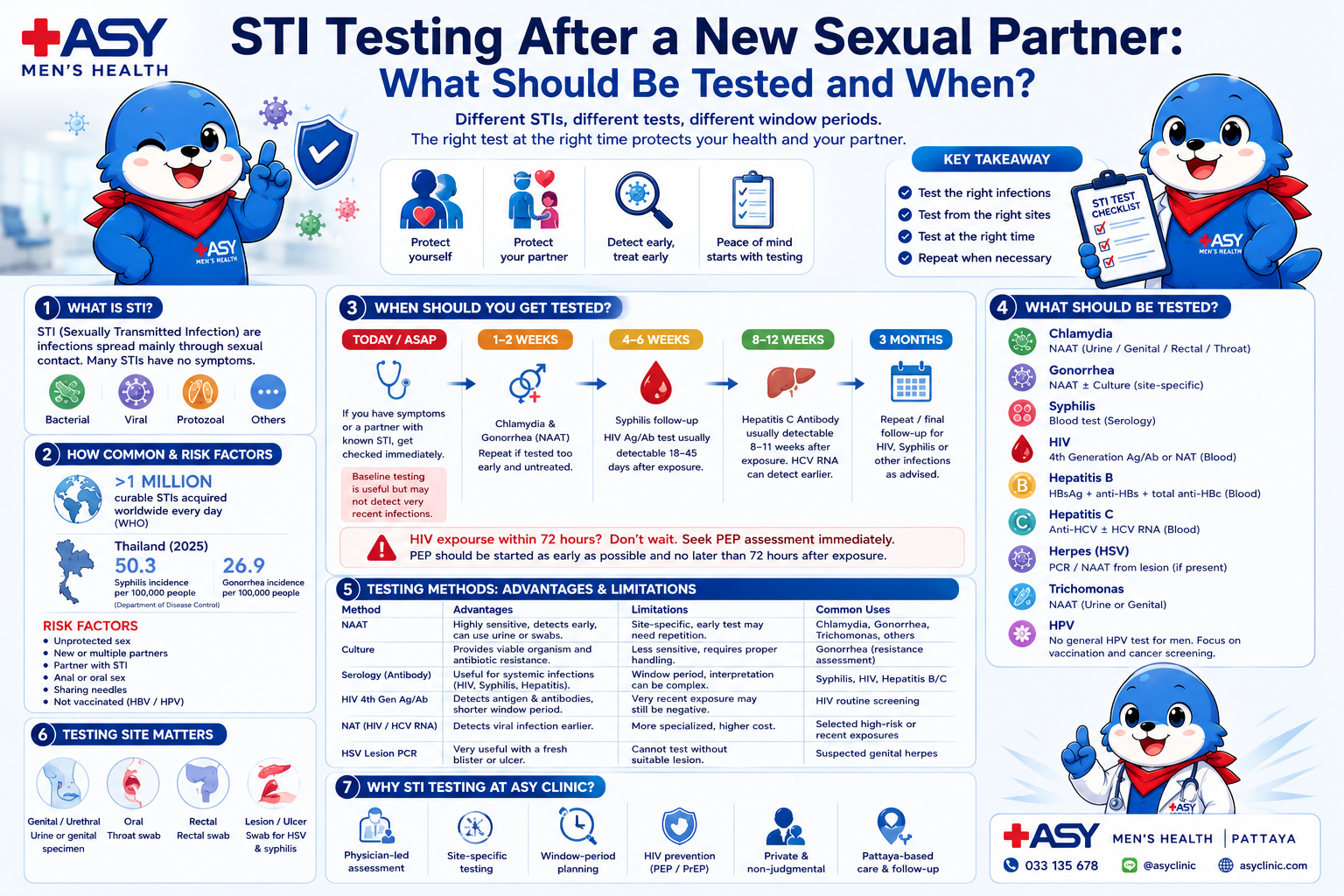
STIs remain extremely common worldwide. The World Health Organization estimates that more than one million curable STIs are acquired every day. In 2020 alone, an estimated 374 million new infections occurred from chlamydia, gonorrhea, syphilis and trichomoniasis combined.
TH STI ยังคงพบได้บ่อยทั่วโลก WHO ประเมินว่ามีการติดเชื้อ STI ที่รักษาให้หายได้ มากกว่า 1 ล้านครั้งต่อวัน และในปี 2020 มีผู้ติดเชื้อใหม่จาก chlamydia, gonorrhea, syphilis และ trichomoniasis รวมกันประมาณ 374 ล้านครั้ง
Thai Department of Disease Control data also show that syphilis has increased substantially in recent years. Reported cases rose from 8,737 in 2019 to 25,469 in 2024. Chonburi has also appeared among provinces with high numbers of newly diagnosed HIV and syphilis cases.
TH ข้อมูลของกรมควบคุมโรคยังแสดงให้เห็นว่า จำนวนผู้ป่วยซิฟิลิสเพิ่มขึ้นจาก 8,737 รายในปี 2562 เป็น 25,469 รายในปี 2567 และชลบุรีอยู่ในกลุ่มจังหวัดที่พบการวินิจฉัย HIV และซิฟิลิสจำนวนสูงของประเทศ
What Makes an Exposure Higher Risk?
Risk is not determined simply by whether a partner is “new.” A new partner means that there may be infection-status information you do not yet know. The actual biological risk depends on the infection, type of sexual contact and prevention used.
TH ความเสี่ยงไม่ได้เกิดจากคำว่า “คู่นอนใหม่” เพียงอย่างเดียว แต่คู่นอนใหม่หมายถึงเราอาจยังไม่ทราบ infection status ของอีกฝ่าย ส่วนความเสี่ยงจริงขึ้นอยู่กับชนิดของเชื้อ รูปแบบของการมีเพศสัมพันธ์ และวิธีป้องกันที่ใช้
Factors That Can Increase STI Risk
- Sex without a barrier method such as a condom
- A partner whose current STI status is unknown
- Having a partner recently diagnosed with an STI
- New or multiple sexual partners
- Anal sex, particularly receptive anal intercourse for HIV transmission
- Oral sex, which can transmit infections such as gonorrhea and syphilis
- Genital sores, inflammation or mucosal trauma
- Sharing injection equipment
- Not being vaccinated against hepatitis B or HPV when vaccination is appropriate
When Should You Get Tested After a New Sexual Partner?
This is probably the most important part of the article: there is no single perfect day to test for every STI.
TH นี่เป็นประเด็นสำคัญที่สุด: ไม่มีวันที่วันเดียวซึ่งเหมาะกับการตรวจ STI ทุกชนิดพร้อมกัน
Different organisms become detectable at different times. Testing too early may produce a negative result even though an infection was recently acquired. This interval is commonly called the window period.
TH เชื้อแต่ละชนิดต้องใช้เวลาต่างกันก่อนที่การตรวจจะสามารถตรวจพบได้ หากตรวจเร็วเกินไป ผลอาจเป็นลบแม้เพิ่งได้รับเชื้อมา ช่วงเวลานี้เรียกว่า window period
Do not wait for the “right testing day.” Seek medical assessment for HIV post-exposure prophylaxis (PEP) as soon as possible. When PEP is indicated, it should be started as early as possible and no later than 72 hours after exposure.
If you have discharge, painful urination, genital ulcers, rash, pelvic/testicular pain, fever, or a partner with a known STI, you should be assessed immediately rather than waiting for a window period.
Baseline testing may identify an infection that was already present before the most recent encounter, but a negative result today may not exclude infection from a very recent exposure.
NAAT testing from the relevant exposure sites can be useful. When initial testing is performed very early and is negative, repeat testing around 1–2 weeks after exposure may be considered if no presumptive treatment was given.
Syphilis serology may still be negative early after infection, so repeat testing at approximately 4–6 weeks may be appropriate after a significant exposure.
A laboratory fourth-generation HIV antigen/antibody test can usually detect infection approximately 18–45 days after exposure in people who have not taken antiretroviral medications.
HCV antibody generally becomes detectable approximately 8–11 weeks after exposure. Earlier HCV RNA testing can detect infection sooner in situations where recent hepatitis C exposure is clinically relevant.
Repeat syphilis or HIV testing may be advised depending on the timing and type of the initial test, whether PEP was used, the source infection status and the clinical scenario.
If you have symptoms, a known infected partner, have used HIV PEP, are taking PrEP, or have ongoing exposure, the schedule should be individualized.
What Should Be Tested?
A useful STI test is not necessarily the panel with the longest list. It is the panel that matches the patient's actual exposure.
TH การตรวจ STI ที่ดีไม่ได้หมายถึง panel ที่มีรายชื่อเชื้อมากที่สุด แต่คือการเลือกตรวจให้ตรงกับรูปแบบความเสี่ยงจริงของแต่ละคน
| Infection | Common Test | Sample | Important Point |
|---|---|---|---|
| Chlamydia | NAAT | Urine / genital / rectal / pharyngeal swab as appropriate | Test the anatomical sites that were actually exposed. |
| Gonorrhea | NAAT ± culture | Urine / genital / rectal / throat specimen | Culture may be needed in selected cases, especially for antimicrobial resistance assessment. |
| Syphilis | Serologic blood testing | Blood | Early infection can occur before antibodies become detectable. |
| HIV | 4th-generation Ag/Ab or NAT in selected cases | Blood | Test choice affects the window period. |
| Hepatitis B | HBsAg + anti-HBs + total anti-HBc | Blood | The triple panel can identify infection, previous exposure and vaccine-related immunity. |
| Hepatitis C | Anti-HCV ± HCV RNA | Blood | HCV RNA can detect recent infection earlier than antibody testing. |
| Herpes (HSV) | PCR / NAAT from a lesion when present | Swab from blister or ulcer | Routine blood screening in asymptomatic low-risk people has important limitations. |
| Trichomonas | NAAT in appropriate patients | Urine or genital specimen | Routine screening depends on anatomy, symptoms and individual risk. |
| HPV | Risk-based cancer screening rather than a universal STI panel | Depends on anatomy and screening indication | There is no general HPV-status test recommended for routine screening of men. |
The Site of Testing Matters Just as Much as the Test
One of the easiest mistakes to make is assuming that a urine test means you have been tested for gonorrhea and chlamydia “everywhere.” It does not.
TH ความเข้าใจผิดที่พบบ่อยคือ หากตรวจปัสสาวะหา gonorrhea และ chlamydia แล้ว แปลว่าได้ตรวจครบทุกตำแหน่ง ซึ่งไม่จริง
The throat, urethra/genital tract and rectum are separate anatomical sites.
What Are the Advantages and Limitations of Different STI Tests?
| Testing Method | Advantages | Limitations | Common Uses |
|---|---|---|---|
| NAAT |
Highly sensitive molecular testing
Can use urine or site-specific swabs. |
Site-specific.
A urine test can miss throat or rectal infection. Very early testing may also require repetition. |
Chlamydia, gonorrhea, trichomonas in selected settings, and other organism-specific tests. |
| Culture | Can provide viable organism and antimicrobial susceptibility information. | Usually less sensitive than modern NAAT and requires proper specimen handling. | Particularly valuable for gonorrhea when treatment failure or antibiotic resistance is a concern. |
| Antibody / Serology | Useful for systemic infections and infections that cannot be diagnosed from urine. |
Requires time for immune markers to develop.
Interpretation can sometimes be complex. |
Syphilis, HIV, hepatitis B and hepatitis C. |
| HIV 4th-Generation Ag/Ab | Detects both HIV antigen and antibodies and shortens the window period compared with antibody-only testing. | A very recent exposure can still be too early to detect. | Routine laboratory HIV screening. |
| Nucleic Acid Testing for HIV/HCV | Can detect viral infection earlier. | More specialized, more expensive and not required as the initial test for every low-risk exposure. | Selected recent or higher-risk exposures. |
| HSV Lesion PCR | Very useful when a fresh suspicious blister or ulcer is present. | Cannot be performed if there is no suitable lesion. | Suspected genital herpes. |
This is also why asking for “everything” can sometimes create confusing rather than useful information. For example, routine herpes blood screening in an asymptomatic low-risk person can generate false-positive or difficult-to-interpret results.
TH นี่เป็นเหตุผลว่าทำไมการขอตรวจ “ทุกเชื้อที่ห้องแล็บมี” ไม่ได้แปลว่าจะได้ข้อมูลที่ดีกว่าเสมอไป ตัวอย่างเช่น herpes blood test ในคนที่ไม่มีอาการและมีความเสี่ยงต่ำ อาจเกิดผล false positive หรือแปลผลได้ยาก
A Negative “Full STI Panel” Does Not Always Mean Zero Risk
Imagine someone has sex on Saturday and requests a full STI panel on Monday. Every result may be negative — but this cannot reliably exclude infections acquired only two days earlier.
TH สมมติว่ามีเพศสัมพันธ์วันเสาร์ แล้วมาตรวจ STI ทุกอย่างในวันจันทร์ ผลทั้งหมดอาจออกมาเป็นลบ แต่ผลนี้ยังไม่สามารถตัดการติดเชื้อจากสองวันที่ผ่านมาได้อย่างน่าเชื่อถือ
The test itself may be excellent. The problem is simply that the biological marker has not had enough time to become detectable.
TH ไม่ได้หมายความว่าการตรวจไม่แม่น แต่เชื้อหรือ immune marker อาจยังไม่เพิ่มขึ้นมากพอ ให้การตรวจสามารถจับได้
choosing the right test and performing it at the right time.
Why Consider STI Testing at ASY Clinic?
At ASY Clinic, the goal is not simply to choose the biggest laboratory panel. STI testing is selected according to the actual exposure, symptoms, timing and anatomical sites involved.
TH ที่ ASY Clinic แนวคิดไม่ใช่การเลือก laboratory panel ที่มีรายชื่อเชื้อมากที่สุด แต่เป็นการเลือกตรวจตามรูปแบบความเสี่ยงจริง อาการ ช่วงเวลาหลังสัมผัส และตำแหน่งที่มี exposure
If you are unsure which tests are appropriate, you can consult a urologist in Pattaya or explore ASY Clinic services.
TH หากไม่แน่ใจว่าควรตรวจอะไรหรือควรตรวจเมื่อไหร่ สามารถปรึกษาแพทย์หรือดูรายละเอียดบริการของ ASY Clinic พัทยาเพิ่มเติมได้
STI Testing After a New Sexual Partner: What Should Be Tested and When?
For many people after a new sexual partner, the core tests to consider are chlamydia, gonorrhea, HIV and syphilis. Hepatitis B, hepatitis C, trichomonas, herpes and other testing may be appropriate depending on the exposure and individual clinical context.
TH โดยทั่วไปหลังมีคู่นอนใหม่ เชื้อหลักที่มักต้องพิจารณา ได้แก่ chlamydia, gonorrhea, HIV และ syphilis ส่วน hepatitis B, hepatitis C, trichomonas, herpes หรือเชื้ออื่นควรเลือกตามรูปแบบความเสี่ยงของแต่ละคน
A Practical Way to Think About It
- If you have symptoms — test now. Do not wait for the window period to finish.
- If HIV exposure may have occurred within 72 hours — seek PEP assessment immediately.
- Use NAAT for chlamydia/gonorrhea at the actual sites of exposure. Urine alone is not always enough.
- Remember that blood tests have window periods. HIV, syphilis and viral hepatitis testing may require appropriate follow-up.
- Do not interpret an early negative test as a guarantee. Timing matters.
- Do not assume the biggest panel is the best panel. Testing should answer a clinical question.
The best STI-testing strategy is therefore not “test everything once.” It is: test the right infections, from the right sites, at the right time — and repeat when medically appropriate.
TH ดังนั้นแนวทางที่เหมาะสมไม่ใช่ “ตรวจทุกอย่างครั้งเดียว” แต่คือ เลือกเชื้อให้ถูก เลือกตำแหน่งตรวจให้ถูก ตรวจในเวลาที่เหมาะสม และตรวจซ้ำเมื่อมีข้อบ่งชี้
Common Questions About STI Testing
Can I test for STIs the day after having sex?
You can be assessed and baseline testing may be useful, particularly if you have symptoms or a known exposure. However, a negative test the following day cannot reliably exclude most infections acquired during that encounter.
TH สามารถมาตรวจและประเมินได้ แต่ผลลบในวันถัดจาก exposure ยังไม่สามารถตัดการติดเชื้อจากเหตุการณ์นั้นได้อย่างน่าเชื่อถือ
Is a urine STI test enough?
Not always. Urine is useful for certain genital or urethral infections, but throat or rectal infection may require site-specific swabs.
TH ไม่เสมอไป ปัสสาวะเหมาะกับการตรวจบางตำแหน่ง แต่หากมี oral หรือ anal exposure อาจต้องเก็บตัวอย่างจากคอหรือทวารหนักเพิ่มเติม
Should herpes be included in every STI blood panel?
Not routinely. CDC does not recommend routine herpes blood screening for most asymptomatic people because of test limitations and the possibility of false-positive results. Testing is more useful when symptoms, lesions or specific clinical risk factors are present.
TH ไม่จำเป็นต้องตรวจทุกราย herpes blood test มีข้อจำกัดในคนที่ไม่มีอาการ และอาจเกิด false positive ได้ การตรวจมีประโยชน์มากขึ้นเมื่อมีอาการหรือมีความเสี่ยงเฉพาะ
Can men get an HPV test after a new partner?
There is no general HPV-status test recommended for routine screening of men. HPV prevention focuses heavily on vaccination, clinical assessment of visible lesions and appropriate cancer-screening programs for eligible populations.
TH ปัจจุบันไม่มีการตรวจ HPV status แบบทั่วไป ที่แนะนำเป็น routine screening สำหรับผู้ชาย การป้องกันจึงเน้น vaccination การตรวจรอยโรคเมื่อมีอาการ และ cancer screening ในกลุ่มที่มีข้อบ่งชี้
Do I need STI testing if I have no symptoms?
Possibly. Many STIs are asymptomatic. The need for testing depends on age, new or multiple partners, type of sexual exposure, partner status and other individual risk factors.
TH อาจจำเป็น เพราะ STI หลายชนิดไม่มีอาการ การตัดสินใจตรวจควรอิงอายุ คู่นอนใหม่ รูปแบบการมีเพศสัมพันธ์ partner status และปัจจัยเสี่ยงอื่นร่วมกัน
STI Testing Is About the Right Test at the Right Time.
If you have had a new sexual partner and are unsure which infections to test for, a medical assessment can help select the appropriate tests, exposure sites and follow-up timing.
หากมีคู่นอนใหม่และไม่แน่ใจว่าควรตรวจโรคอะไร ควรเก็บตัวอย่างจากตำแหน่งไหน หรือผลลบครั้งแรกเชื่อถือได้แค่ไหน สามารถประเมินความเสี่ยงและวางแผนการตรวจตามช่วงเวลาได้
References
- World Health Organization (WHO). Sexually Transmitted Infections (STIs) Fact Sheet. Global estimates of chlamydia, gonorrhea, syphilis and trichomoniasis.
- Thailand Department of Disease Control. HIV and Sexually Transmitted Infection Situation in Thailand. 2025–2026 surveillance information.
- Centers for Disease Control and Prevention (CDC). Getting Tested for STIs. Updated March 2026.
- Centers for Disease Control and Prevention (CDC). STI Screening Recommendations. Chlamydia, gonorrhea, syphilis, HIV, hepatitis and site-specific screening guidance.
- Centers for Disease Control and Prevention (CDC). Sexually Transmitted Infections Treatment Guidelines. Diagnostic testing and follow-up recommendations.
- Centers for Disease Control and Prevention (CDC). Antiretroviral Postexposure Prophylaxis After Sexual, Injection Drug Use, or Other Nonoccupational Exposure to HIV. 2025 recommendations.
- Centers for Disease Control and Prevention (CDC). HIV Testing. HIV antibody, antigen/antibody and nucleic-acid testing window periods.
- Centers for Disease Control and Prevention (CDC). Screening and Testing for Hepatitis B Virus Infection. Triple-panel testing recommendations.
- Centers for Disease Control and Prevention (CDC). Clinical Screening and Diagnosis for Hepatitis C. Anti-HCV and HCV-RNA testing.
- Centers for Disease Control and Prevention (CDC). Screening for Genital Herpes. Recommendations and limitations of HSV testing.
- Centers for Disease Control and Prevention (CDC). Human Papillomavirus Infection — STI Treatment Guidelines. HPV testing and screening recommendations.
Dr. Sirirat Nakdang, MD
Urologist • ASY Clinic Pattaya
นพ. สิริรัฐ นาคแดง แพทย์เฉพาะทางระบบทางเดินปัสสาวะ
This article is provided for general medical education and does not replace individualized diagnosis or treatment. Testing schedules may differ according to symptoms, exposure type, HIV PrEP or PEP use, vaccination status and individual clinical risk.