
A clinical analysis of Testosterone Replacement Therapy (TRT), prostate cancer risk, the Saturation Model, and modern urological safety guidelines.
Book ConsultationQuick Summary
- No Causal Link: Extensive contemporary clinical trials and meta-analyses demonstrate that Testosterone Replacement Therapy (TRT) does NOT cause or initiate new prostate cancer in men with a healthy prostate gland.
- The Saturation Model: Prostate tissue androgen receptors become fully saturated at relatively low testosterone levels (~120–250 ng/dL). Raising testosterone above this threshold does not stimulate additional prostate cell growth.
- Absolute Contraindication: TRT must NOT be given to men with active, untreated prostate cancer, as testosterone can fuel the growth of existing malignant cells.
- Mandatory Pre-TRT Screening: Baseline Prostate-Specific Antigen (PSA) blood testing and digital rectal examination (DRE) are essential before commencing TRT.
- Physician Monitoring: Supervised TRT requires periodic safety checks (PSA and Hematocrit) to ensure long-term health and early detection of any urological changes.
Table of Contents
1. The Origin of the "TRT Causes Cancer" Myth 2. Understanding the Saturation Model 3. What Modern Research & Meta-Analyses Show 4. Absolute Contraindications & Precautions 5. Essential Prostate Safety Protocol Before & During TRT 6. The ASY Clinic Men's Health Protocol 7. Key Takeaways1. The Origin of the "TRT Causes Cancer" Myth
For decades, many patients—and even medical providers—believed that raising testosterone levels via Testosterone Replacement Therapy (TRT) directly caused or triggered prostate cancer.
This long-standing belief originated from Nobel Prize-winning research by Dr. Charles Huggins in 1941, which showed that removing testosterone (castration) caused metastatic prostate cancer tumors to shrink. From this, the medical community wrongly extrapolated that if removing testosterone shrinks cancer, then adding testosterone must cause cancer.
However, modern urological research led by Harvard Medical School researchers (such as Dr. Abraham Morgentaler) has completely revolutionized this view, establishing the difference between causing new cancer and stimulating existing cancer.
2. Understanding the Saturation Model
To understand why TRT does not cause prostate cancer in healthy men, urologists refer to the Saturation Model:
The prostate gland contains androgen receptors (AR) that bind to circulating testosterone and dihydrotestosterone (DHT). However, the capacity of these receptors to bind hormone molecules is limited.
| Serum Testosterone Level | Prostate Receptor Status | Biological Effect on Prostate Tissue |
|---|---|---|
| Castrate Level (<50 ng/dL) | Receptors unsaturated | Prostate tissue shrinks; cancer cell apoptosis occurs. |
| Near Threshold (50–250 ng/dL) | Receptors filling rapidly | Prostate tissue grows toward normal physiological size. |
| Physiological Level (>250 ng/dL) | Receptors Fully Saturated | No additional binding or tissue growth occurs, even if serum testosterone rises further. |
In simple terms, once serum testosterone reaches approximately 150–250 ng/dL, the prostate's androgen receptors are completely full (saturated). Increasing serum testosterone levels into the optimal physiological range (e.g., 600–900 ng/dL) through TRT does not trigger additional cellular growth or cause malignant transformation.
💡 Clinical Analogy: The Plant & Water Model
Think of the prostate as a plant and testosterone as water. If a plant is completely dried out (castrate state), adding water revives it. But once the soil is thoroughly saturated, adding extra water does not make the plant grow into a giant tree—the soil simply cannot hold any more water.
3. What Modern Research & Meta-Analyses Show
Multiple large-scale studies confirm the safety profile of TRT regarding prostate health:
- The TRAVERSE Trial (2023): The largest prospective randomized controlled trial on TRT safety (over 5,200 men monitored over several years) published in the New England Journal of Medicine (NEJM) found **no increase in high-grade prostate cancer risk** or major adverse prostate events in the TRT group compared to placebo.
- Meta-Analyses: Pooled data from dozens of clinical trials show no statistically significant difference in prostate cancer incidence between men receiving TRT and those receiving placebo.
- Endocrine Society & AUA Guidelines: Both the American Urological Association (AUA) and European Association of Urology (EAU) state that TRT does not increase the risk of developing prostate cancer.
4. Absolute Contraindications & Precautions
While TRT does not *cause* cancer, it is essential to distinguish between a healthy prostate and a prostate with existing malignant cells:
- Active, Untreated Prostate Cancer: TRT is strictly contraindicated in men with active or metastatic prostate cancer, as testosterone can fuel the growth rate of pre-existing malignant cells.
- Elevated PSA / Suspicious Lesions: Men with unexplained elevated Prostate-Specific Antigen (PSA) levels or abnormal digital rectal exam (DRE) results must undergo full urological investigation (e.g., mpMRI / PI-RADS assessment) to rule out cancer before starting TRT.
- Severe Severe BPH / Urinary Retention: While TRT does not worsen mild Benign Prostatic Hyperplasia (BPH), untreated severe urinary obstruction should be managed before starting therapy.
5. Essential Prostate Safety Protocol Before & During TRT
Responsible medical management eliminates unnecessary risk through structured screening:
- Baseline Assessment: Measure Total & Free Testosterone, PSA, Free PSA ratio, Complete Blood Count (Hematocrit), and perform DRE prior to initiating therapy.
- 3-Month Checkup: Re-evaluate Total T, Free T, PSA, and Hematocrit to confirm correct dosing and physiological tolerance.
- Annual Monitoring: Perform annual PSA blood tests and health reviews. A rapid, unexpected rise in PSA (>1.4 ng/mL within 12 months) warrants urological investigation.
6. The ASY Clinic Men's Health Protocol
At ASY Clinic, patient safety is our highest priority. Our urology-led hormonal optimization protocol includes:
- Urologist-Supervised Care: Direct evaluation by certified urologists to ensure complete prostate and endocrine safety.
- Comprehensive Biomarker Tracking: Monitoring PSA, Free PSA, PSA Density, Hematocrit, Estradiol, and Metabolic Health.
- Advanced Imaging Referral Pathways: Direct access to 3T mpMRI (PI-RADS scoring) if any suspicious prostate changes are detected during therapy.
7. Key Takeaways
- No Cancer Initiation: TRT does NOT cause prostate cancer in men with healthy prostate glands.
- Backed by Science: The Saturation Model and large RCTs (like TRAVERSE 2023) confirm that physiological TRT is prostate-safe.
- Screening Is Mandatory: TRT must never be started without a baseline PSA check and physical examination to ensure no pre-existing cancer is present.
- Specialist Guidance: Under proper urological supervision, TRT safely restores energy, vitality, muscle, and sexual health without increasing prostate cancer risk.
Frequently Asked Questions
Will my PSA levels go up after starting TRT?
It is normal to see a slight, modest rise in PSA (typically 0.2 to 0.5 ng/mL) during the first 3 to 6 months of TRT as the prostate adjusts to physiological hormone levels. However, a sharp rise above 1.4 ng/mL in a single year requires urological evaluation.
Can men who had prostate cancer in the past ever receive TRT?
In select cases, men who have been successfully treated for low-risk prostate cancer (e.g., via radical prostatectomy or radiation) and remain disease-free with undetectable PSA levels for several years may be considered for TRT under strict urological supervision.
Does TRT make the prostate grow larger (BPH)?
Clinical studies show that TRT in physiological doses does not cause significant enlargement of the prostate or worsen Benign Prostatic Hyperplasia (BPH) symptoms in healthy men.
What happens if my PSA rises while on TRT?
If PSA levels rise significantly during TRT, therapy is paused while your urologist conducts further diagnostic evaluations, such as repeating the PSA test, checking PSA Density, or ordering a prostate mpMRI scan.
About the Author
Dr. Sirirat Nakdang
นพ. สิริรัฐ นาคแดง
ศัลยแพทย์ทางเดินปัสสาวะและระบบสืบพันธุ์เพศชาย
Urologist & Men's Health Specialist
Sirirat Nakdang, MD
Specialist in Urological Safety, TRT & Men's Precision Medicine
Thai Medical License No. ว55466
References
- Morgentaler, A., & Traish, A. M. (2009). Shifting the paradigm of testosterone and prostate cancer: the saturation model and the limits of androgen-dependent growth. European Urology, 55(2), 310–320.
- Lincoff, A. M., et al. (2023). Cardiovascular Safety of Testosterone-Replacement Therapy (TRAVERSE Trial). The New England Journal of Medicine, 389(2), 107–117.
- Bhasin, S., et al. (2018). Testosterone Therapy in Men With Hypogonadism: An Endocrine Society Clinical Practice Guideline. The Journal of Clinical Endocrinology & Metabolism, 103(5), 1715–1744.
- Mulhall, J. P., et al. (2018). Evaluation and Management of Testosterone Deficiency: AUA Guideline. The Journal of Urology, 200(2), 423–432.
Consultation & Safe TRT Screening
Evaluate your testosterone levels and prostate health safely with specialist care at ASY Clinic.
Book Consultation
Painless hematuria
Painless blood in urine (Hematuria) may appear only once and disappear, but it should never be ignored. Learn about possible causes—including stones, prostate conditions, kidney disease and urinary tract cancer—and when to see a urologist.
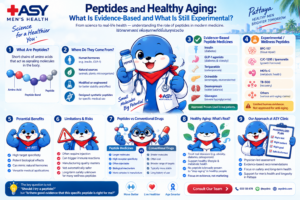
Peptides and Healthy Aging: Evidence vs Experimental | Peptide Pattaya
Peptides are not automatically experimental. Insulin, GLP-1 medicines, teriparatide and many other peptide drugs are established medical therapies. But many peptides promoted for longevity or anti-aging still lack robust human evidence.
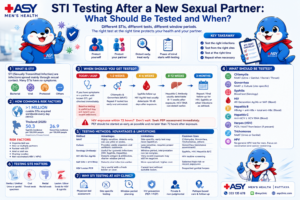
STI Testing After a New Sexual Partner: What to Test & When | Pattaya
STI testing after a new sexual partner is not simply one “full panel” done on one day. Different infections require different samples and have different window periods. Learn what to test, when to test, and when repeat testing may be needed.